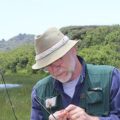
Life is full of lessons, and many of mine have been learned with a fly rod in hand. If you’ve followed the journeys I’ve shared here, you already know that. This particular tale is about a very practical one for anyone who fishes and the events that led up to it. In the process, I’m going to introduce you to another gem of a place in Wyoming.
I found the location quite accidentally, while still living and working at Table Rock, in the southwestern part of the state. One of the perks of living there was access to hundreds of acres of BLM land and all the trail roads. The adventurous souls among us put in many miles on those dirt roads. During one of those adventures, my family and I had taken a new fork on a northwesterly route that ended at a junction with a two-lane highway, and a sign pointing north that read, “Louis Lake, 10”.
Well, we’d come all the way across Oregon Buttes and we weren’t going to stop exploring at that point. We made our way to the lake and campground and fell in love at first sight. We were just out for a day of driving and exploring, and had burned up most of the daylight. Tomorrow was a work day, and we needed to head back. We knew the highway we’d come in on would lead back to Highway 191, ran south back to I-80. From there, we’d have a fast, 35-mile drive back home.
We’d take that shortcut across the Red Desert many times after that day. Although the lake was popular with the locals of Lander, only an hour away, most would head home early on weekdays. Our families camped overnight. We learned that the wind usually died down and the lake went calm in the late afternoon, around 5:00. The calm surface and increased bug activity enticed the trout to rise and it was a beautiful thing to see.
Now, let’s jump forward several years. I was no longer at Table Rock, but living with my second wife, Janie, in Casper, Wyoming. We both worked, and life was good. We also camped at Louis Lake often. Unlike the route from Table Rock, the trip from Casper takes a while. It’s roughly 180 miles, and there are a few routes to choose from. The two most used are via Highway 26, curving to the north, and Highway 287, arcing southward. Both are interesting drives and there are some great stops along the way.
The third route runs straight between the two highways and cuts several miles from the trip. It’s also interesting, in that it runs through the uranium mining district, and there are radiation warning signs with flashing red lights. There are also a couple of side routes that lead up to Highway 26. Taking a wrong turn can lead you to closed gates with guard stations, or can simply add to the adventure.
We’d traveled both main routes, but avoided the more direct route, despite several recommendations from friends. More on that in a while. For now, allow me to get back on track with this particular adventure.
Janie and I had decided to take a quick Sunday trip to the lake and that meant leaving before dawn and returning that night, to catch a few hours of sleep before heading to our respective jobs. Day trips weren’t really our cup of tea, but we’d take what we could work into our schedules. We loaded up, took Highway 26, and made it to the campground early enough to get a good space.
Once we got things organized, we took a quick drive to the lodge to rent a little 14-foot aluminum boat with a 10-horsepower outboard. We didn’t have a boat of our own at the time, and their day rate was very reasonable, with fuel included. I drove the boat back to camp and we tossed in our gear and worked our way around the lake, casting in some of the few available spots between the dozens of people fishing from the banks. It was a typical Sunday, with an assortment of bait casters and lure lobbers of all ages.
We kept our distance and worked our flies around the snags and banks, releasing a few small trout. We knew what was coming up later and the fish we were there for. There was a fair breeze and a little bit of chop, but the sun was warm and we enjoyed watching the families, returning the happy waves of the little ones.
We swung back into camp for a late lunch, a leg stretch and a bathroom break. There wasn’t any need to rush, so we’d brought along some hot dogs and fixin’s. We roasted and enjoyed a few, hydrated, and just killed some time in the woods.
As the afternoon passed, the campers started to thin out. That was typical, as I mentioned. Responsible, working parents were out for an overnighter or day trip with the kids, and at least one job to get back to in town, due to the slow access routes from the highway. We’d have the lake mostly to ourselves soon.
As expected, there were only a few of us die-hards still around long before dark, and a few of us were making our boats ready. When the wind began to die down, those of us “in the know” pushed off and chose our paths. Some would be trolling near the bank. Janie and I went straight out, to the middle of the lake and shut the motor down. We didn’t bother with the anchor, we’d just drift while we readied our gear.
If you’ve never cast flies with another fly fisher in a small boat, let me assure you, it takes some coordination. Janie and I had done this before and knew the ropes. She took the bow, while I manned the stern to fire up the engine when we needed to adjust our position.
It wasn’t too long before the magic we’d been waiting for began. The wind died. The surface of the lake turned to glass, and slowly, circles began to appear on the water as the fish began to sip bugs from the surface. That, of course, was our cue, and we both started casting to those circles.
I’d started with my favorite fly for this lake, and some other areas, a size 16 Blue Dun. Janie had opted for something more visible; a white miller, also a size 16. Both choices were right. We’d each landed a couple of fat, 18-inch Rainbows and could catch 2 more apiece before we were done.
I was in the zone, drying my fly with several false casts as I worked out line, then letting it stretch out to deliver the fly gently on that smooth water. I knew exactly where Janie and her line were and vice-versa. Then things took a turn.
Janie saw something in the water and said, “What’s that?” I stopped dead, just as I was starting my forecast. My line lost its momentum, and as I turned to face her, my leader ever-so-slowly wrapped loosely around her neck and swiped up to embed that cute little fly in her left cheek.
I was mortified. Janie was shocked, but brave. I clipped the leader and tried to fix the problem. She put up with my futile attempts to remove that fly, tears in her eyes, but no complaints. I couldn’t stop apologizing and I couldn’t get the hook to budge. Understand, I grew up with a dad who would push a hook through the skin, clip the barb off and slip the rest out backward. It works, if you have a big enough hook to maneuver it. It also hurts, and I knew every movement of that hook was painful. Worse, I wasn’t making any progress. The bug was buried up to its butt and wasn’t going anywhere. Worst of all, we would be losing the light soon.
We secured the camp as best we could and headed to the ER in Lander. Janie walked calmly up to the desk, with her hand casually on her cheek. The receptionist asked what the problem was, and when the hand was removed, she blinked and remarked, “Oh.”
We weren’t there for long, and a doctor who also enjoyed fly fishing politely showed me how to remove a hook quickly, easily, and with very little pain. It requires a piece of strong fishing line and a pair of hemostats. The barb on the hook will follow the same channel it made on the way in, so there’s no further damage done.
A little dab with an alcohol wipe and the job was done. The biggest surprise was when he told the PA there would be no charge for the procedure. My guess was that was due more to my wife’s smile than sympathy for her idiot husband, and I was fine with that. We headed back up to the campground as fast as I dared drive in the dark.
I returned the boat to the dock, let the person on duty know, and joined Janie, waiting out front. She moved over to let me drive, and we made the trip back to the campground in record time. Ten minutes later, we were on our way home, driving through Gas Hills for the first time.
The adventure wasn’t quite over, but I’ll save that story for another time. For now, suffice it to say that we went into our jobs with no sleep that Monday morning.
By the way, there’s always a pair or two of hemostats and a loop of strong mono in my fishing vests.